
Table of Contents
- Why Free Feeding Leads to Pet Overeating
- Signs of Pet Obesity and When to See Your Vet
- How to Measure Pet Food Correctly for Every Meal
- Slow Feeder Benefits for Pets: Bowls, Puzzles, and Lick Mats
- Managing Multi-Pet Households and Food Aggression
- Nutritional Density vs. Volume: Feeding Less Without Guilt
- Psychological Enrichment Alternatives to Table Scraps
- Frequently Asked Questions
Last Updated: September 29, 2026
Why Free Feeding Leads to Pet Overeating
Learning how to stop pet overeating starts with one hard truth: the all-day buffet is usually the cause. Free feeding turns every meal into an endless snack session.
The core problem is not willpower. It is structure.
Signs of Pet Obesity and When to See Your Vet
The clearest sign of pet obesity is a body condition score above ideal. Vets use a 1-9 scale, where 4-5 is healthy for most dogs and cats. At home, feel the ribs, they should be easy to find under a thin fat layer, and check for a visible waist from above and a belly that tucks up from the side.
Watch for these warning signs:
- Ribs you cannot feel without pressing hard
- No visible waist from above
- A round, sagging belly
- Reluctance to walk, jump, or play
- Heavy panting after short activity
How to Measure Pet Food Correctly for Every Meal
Measuring pet food correctly means using a kitchen scale, not a scoop, scoops vary wildly, and a heaped scoop can add many extra calories daily. The routine:
- Check the bag or tin for the feeding guide by weight.
- Weigh your pet's daily portion on a kitchen scale in grams.
- Split that total across the number of meals you feed.
- Serve each meal in the same bowl at the same times.
- Adjust every two weeks based on body condition, not appetite.
Using a Food Diary to Track Caloric Intake
A food diary records everything your pet eats and drinks daily. It takes two minutes and exposes hidden calories fast. Track:
- Time of meal
- Food type and brand
- Weight in grams
- Treats and table scraps
- Notes on appetite or behaviour
After one week, patterns appear, treats adding a full meal's worth of calories, or one family member feeding extra "just because." Take the diary to your vet to turn a vague conversation into a precise one.
Slow Feeder Benefits for Pets: Bowls, Puzzles, and Lick Mats
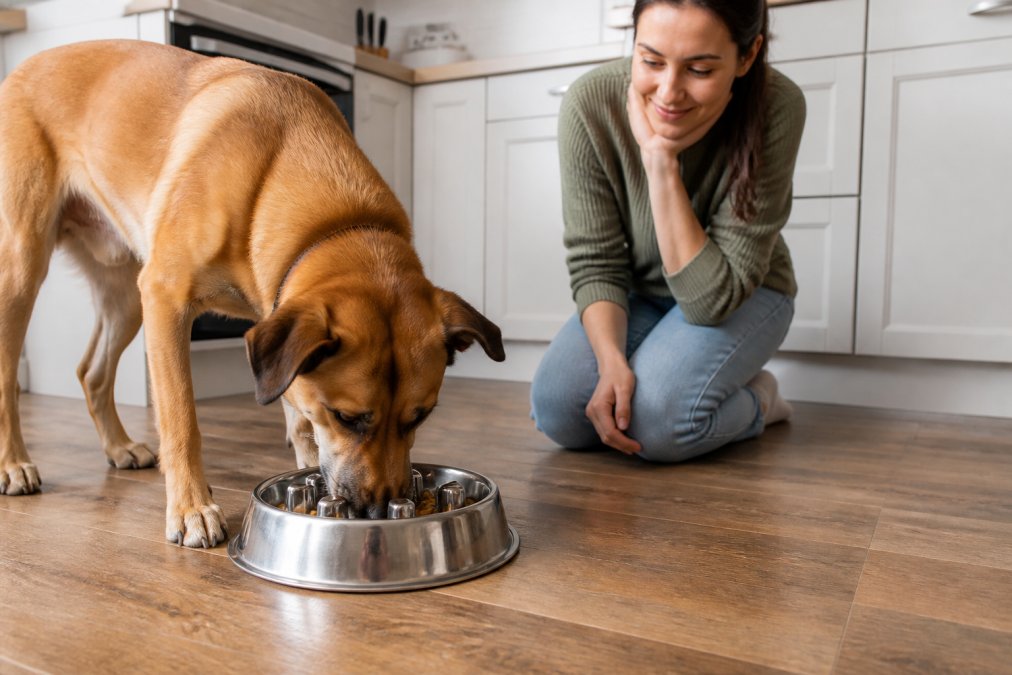
FEASTY PAWS offers a stainless steel slow feeder bowl with meal-lengthening ridges designed to slow eating by up to three times. It holds two cups, fits small to medium breeds, has a non-slip base, and resists the chewing damage common with plastic bowls. For variety:
- Slow feeder bowls for everyday meals
- Puzzle feeders that hide food behind layers
- Lick mats for wet food and treats
How to Introduce a Slow Feeder Without Frustration
Start with the easiest setting and a food your pet already loves, putting a few pieces on top of the ridges so success comes fast. Then:

- Feed one meal a day in the new bowl for the first week.
- Keep the other meals in the old bowl to reduce stress.
- Praise your pet when they finish.
- Add a layer of difficulty only after two calm meals.
If your pet walks away, do not force it. Try a lick mat instead, which is gentler for anxious eaters.
Managing Multi-Pet Households and Food Aggression
Multi-pet homes are where portion control quietly collapses. One pet finishes first, then cleans up the other's bowl; over months, both drift from their correct portions unnoticed. Food becomes a resource to defend, which is why simply putting two bowls on the floor rarely works, even when both pets seem friendly.
The Separate-Feeding Protocol That Actually Works
Separate feeding is the fix, but the details matter. A routine behaviorists and veterinary nutritionists recommend:
- Assign each pet a fixed feeding station in a different room, crate, or gated area. The station should be out of sight and smell range of the others.
- Feed at the same times every day. Predictability lowers anxiety and reduces guarding.
- Close the door or latch the gate. Do not rely on verbal commands alone.
- Set a 15-minute window. After that, pick up whatever is left, even if the bowl is not empty. This teaches that food is available only during the window.
- Release pets one at a time after all bowls are removed. This prevents the fastest eater from rushing the slowest.
Reading Food-Guarding Signals Before They Escalate
Food aggression rarely appears without warning. Watch for these early signals:
- Stiff body posture over the bowl, with weight shifted forward
- Hard, fixed stare at an approaching pet or person
- Growling, lip curling, or snapping when someone comes near
- Eating faster the moment another pet enters the room
- Standing over the bowl without eating, blocking access
When to Bring in a Professional
If guarding continues after two to three weeks of strict separate feeding, or if any bite has occurred, ask your vet for a referral to a veterinary behaviorist. This is a safety issue, not a training quirk. A behaviorist can assess whether anxiety, pain, or a medical issue drives the behavior.
Dog Bowls Slow Feeder Stainless Steel →
The Hidden Calorie Leak in Multi-Pet Homes
Even with separate feeding, calories leak. A common pattern: one pet eats slowly, the other fast, and the fast one gets extra bites before you intervene, over a week, a full extra meal. Track each pet separately for one week, noting who eats what and when. You may find the 'underweight' pet is stealing from the 'overweight' one, or that both get extra treats from different family members.
Nutritional Density vs. Volume: Feeding Less Without Guilt
Feeding less does not have to mean your pet feels deprived. The trick is nutrient density: more nutrition per gram, not more grams. A food with higher protein and quality fats keeps pets full longer on a smaller portion; cheap filler-heavy foods do the opposite, leaving your pet hungry an hour later.
Check the label for:
- A named meat as the first ingredient
- Protein content suited to your pet's age and activity
- A calorie count per 100g, so you can compare fairly
Psychological Enrichment Alternatives to Table Scraps
Most begging is not hunger, it is a request for attention, and scraps are the easiest answer. Every scrap reinforces the cycle: pet begs, human gives, pet learns that begging works. The fix is not to ignore your pet but to replace the scrap with an activity that delivers the same reward, your focus, without the calories.
The Non-Food Reward Menu
Build a rotation of calorie-free rewards. Variety is key, so your pet does not get bored and return to begging.
- Puzzle feeders with part of the daily ration. Instead of a biscuit, put a handful of their regular kibble into a puzzle toy. They work for it, and the calories come out of the daily total, not on top of it.
- Sniff walks. A 10-minute walk where your pet leads and sniffs freely is mentally exhausting in a good way. It mimics foraging behavior and reduces the attention-seeking that drives begging.
- Scent work at home. Hide a few pieces of kibble around a room and let your pet find them. Start with easy hides, then increase difficulty. This taps into natural foraging drives.
- Frozen lick mats. Spread a small amount of wet food or plain yogurt on a lick mat and freeze it. This gives a long-lasting activity while you eat dinner.
- Training sessions with their own food. Teach a new trick or practice an old one, rewarding with pieces of their regular meal. Five minutes of training is often more satisfying than a scrap.
- Tug or fetch before meals. A short burst of physical play before feeding time reduces attention-seeking during your meal.
How to Build a Daily Enrichment Schedule
The mistake most owners make is trying one enrichment activity, seeing it work once, then stopping. Enrichment works when it is consistent. A simple daily framework:

- Morning: Feed part of the daily ration in a puzzle feeder or scatter it in a snuffle mat.
- Midday: A sniff walk or a short training session.
- Evening: A frozen lick mat or a chew toy while you eat dinner.
- Before bed: A few minutes of calm petting or grooming, attention without food.
Replacing the Begging Cycle Step by Step
Begging is a learned behavior that extinguishes slowly. Here is how to replace it:
- Identify the trigger. Does your pet beg when you open the fridge? When you sit on the couch? When you finish your plate? Knowing the trigger helps you intervene earlier.
- Redirect before the behavior starts. If your pet begs when you sit down to eat, give them a frozen lick mat or puzzle toy at the same time.
- Reward calm behavior. When your pet lies down quietly while you eat, toss a piece of their regular food or offer quiet praise. Do not wait for them to beg first.
- Be consistent across the household. If one family member gives scraps, the behavior will persist. Everyone needs to follow the same rules.
- Expect an extinction burst. When you stop giving scraps, your pet may beg harder for a few days. This is normal. Stay consistent, and the behavior will fade.
Why This Works Better Than Willpower
Willpower fails because it asks you to resist a persistent, attention-seeking behavior without offering an alternative. Enrichment works because it meets the underlying need, mental stimulation and social connection, without the calories. Owners who build a consistent enrichment routine typically see begging drop within two to three weeks. Start before the behavior becomes ingrained, and treat enrichment as part of the daily routine, not an occasional treat.
Frequently Asked Questions
How do I get my dog to stop overeating?
Start by switching from free feeding to scheduled meals. Measure portions with a kitchen scale or standard measuring cup based on your vet's recommendation. Use a slow feeder bowl to extend mealtime and prevent gulping. Remove table scraps entirely and replace them with healthy, low-calorie treats during training. Most dogs adjust within two weeks when the routine stays consistent. If your dog shows food aggression or continues gaining weight, schedule a veterinary consultation to rule out underlying conditions.
What are the signs that my pet is overfed?
Common signs include weight gain, a rounded belly, difficulty feeling the ribs, and reduced activity levels. You may also notice your pet begging more frequently or eating very quickly. A body condition score helps you assess whether your pet is at a healthy weight. If you can't feel the ribs easily or see a visible waistline from above, your pet may be carrying extra weight. Consult your vet for a proper assessment and weight management plan.
Are gravity feeders good for pets that overeat?
Gravity feeders work well for pets that self-regulate, but they can worsen overeating in food-motivated animals. If your pet eats everything available, a gravity feeder gives constant access and makes portion control impossible. For those pets, scheduled meals with measured portions and a slow feeder bowl are better options. FEASTY PAWS offers a gravity-fed system that suits pets with healthy eating habits, but always monitor your pet's weight and adjust as needed.
How can I tell if my pet is at a healthy weight?
Run your hands along your pet's ribcage. You should feel the ribs easily without pressing hard, similar to feeling the back of your hand. From above, you should see a visible waist behind the ribs. From the side, the belly should tuck up toward the hind legs. If you can't feel the ribs or see a waist, your pet may be overweight. Your vet can confirm with a body condition score and recommend a target weight.
Stopping pet overeating is a structure problem, not a discipline problem. Measure the food, slow the meal, separate multi-pet bowls, and replace scraps with enrichment. FEASTY PAWS was built by pet parents for exactly this: a gravity-fed all-day feeder that keeps food and water available without batteries or timers, backed by free shipping and a 30-day money-back guarantee. Get started with FEASTY PAWS and enjoy more playtime with a healthier, happier companion.